Tell us a little bit about yourself
My name is Beth, Bethany’s the full version, but I usually go by Beth nowadays. I’m 25 years old, I was born in Invercargill, and I’m doing a Bachelor of Environmental Management, so a Bachelor of Science, at the Southern Institute of Technology (SIT). I want to work towards what really matters to me, which is nature and conservation; preserving and the natural world that we have.
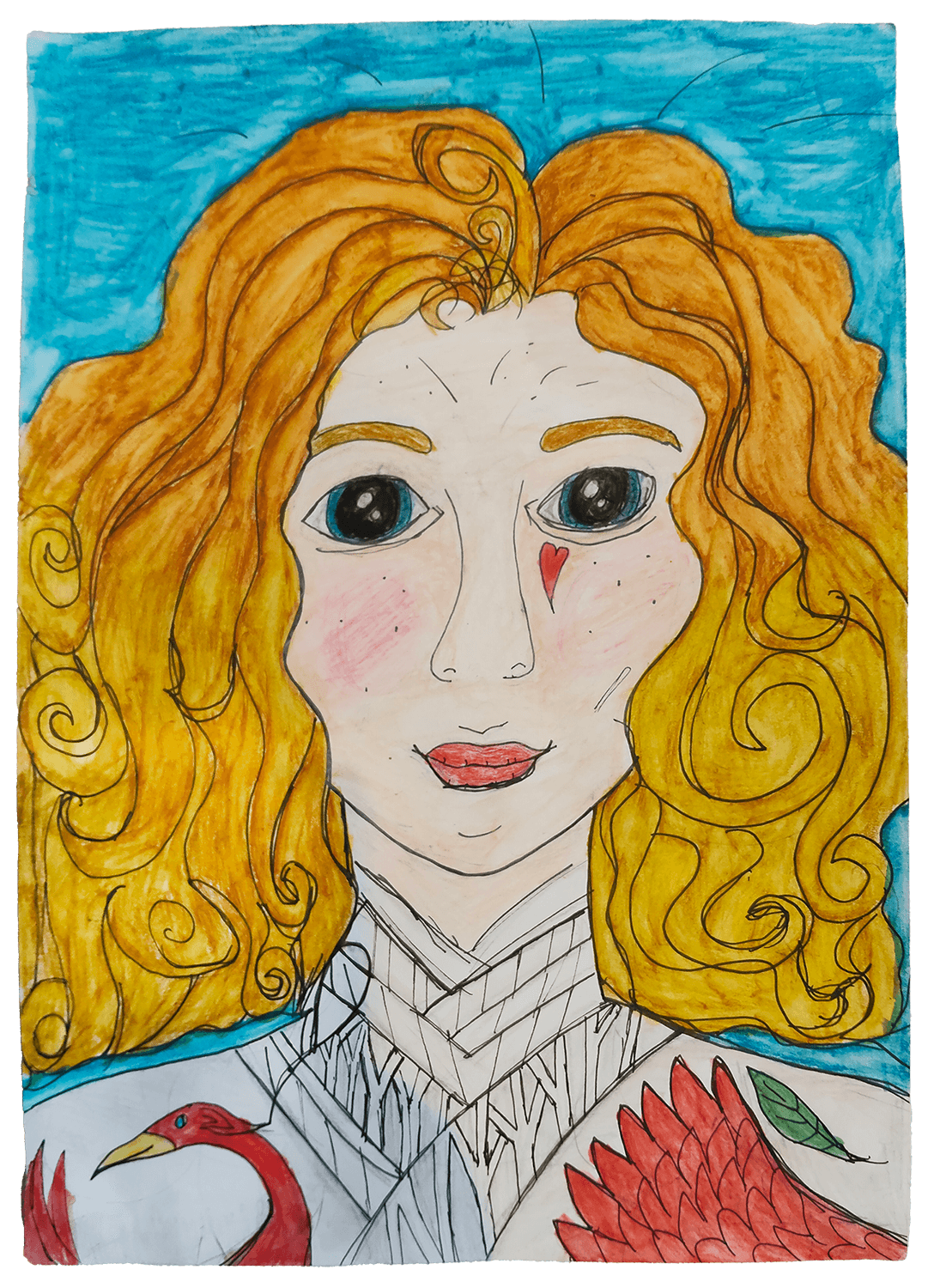
Beth’s illustration of one of her fictional characters, Sylvie.
Aside from studying, I do art and writing in my spare time; mostly creative writing and drawings of birds and dragons, but occasionally people, just little sketches every now and then. I use creative writing as a medium to express how I see the world. It’s deeply important to me; I write at least a small journal entry almost every day. Apart from that, I also like hobbies such as exploring nature, bird watching, and watching sci-fi or fantasy films. I enjoy reading too. I’m trying to get back into that a bit more because it’s a lot better for you than just watching, or you know, scrolling on social media, which is not good for my brain.
Could you share a bit about your diagnostic journey?
A lot of what my mother mentioned in her interview – the early events – I don’t remember at all. I know I was diagnosed at five, although I don’t remember it. Actually, I only found out when I was ten, when I was given a book called All Cats Have Asperger Syndrome.* That was very important to me because it helped me to understand why I had the experiences that I did; feeling excluded at school; never really understanding why I was deeply emotionally sensitive as well.
A common perception about autism is that we don’t really have, or don’t feel emotions deeply. When for a lot of Autistic people, it couldn’t be further from the truth. I’ve always felt especially strongly for animals. Any type of fear of animal suffering always upset me and still does today.
How do you relate to cats because of that book and in general?
Cats get so much flak for communicating their needs differently, and I think that’s why I’ve always been really drawn to them. I recognise similarities to myself in how they clearly communicate how they’re feeling. They’re very straightforward. If they’re happy, you know it. If they’re annoyed, then it’ll be twitching its tail or trying to move away from you or yelling (you shouldn’t let it get that bad!). With all the cats I’ve had, I’ve developed very close bonds. I relate to cats because, like Autistic people, they’re misunderstood and interpreted as being cold and unfeeling because they don’t express their feelings the same, extroverted way dogs do. They’re dismissed as being annoying, temperamental, moody creatures that are difficult to understand.
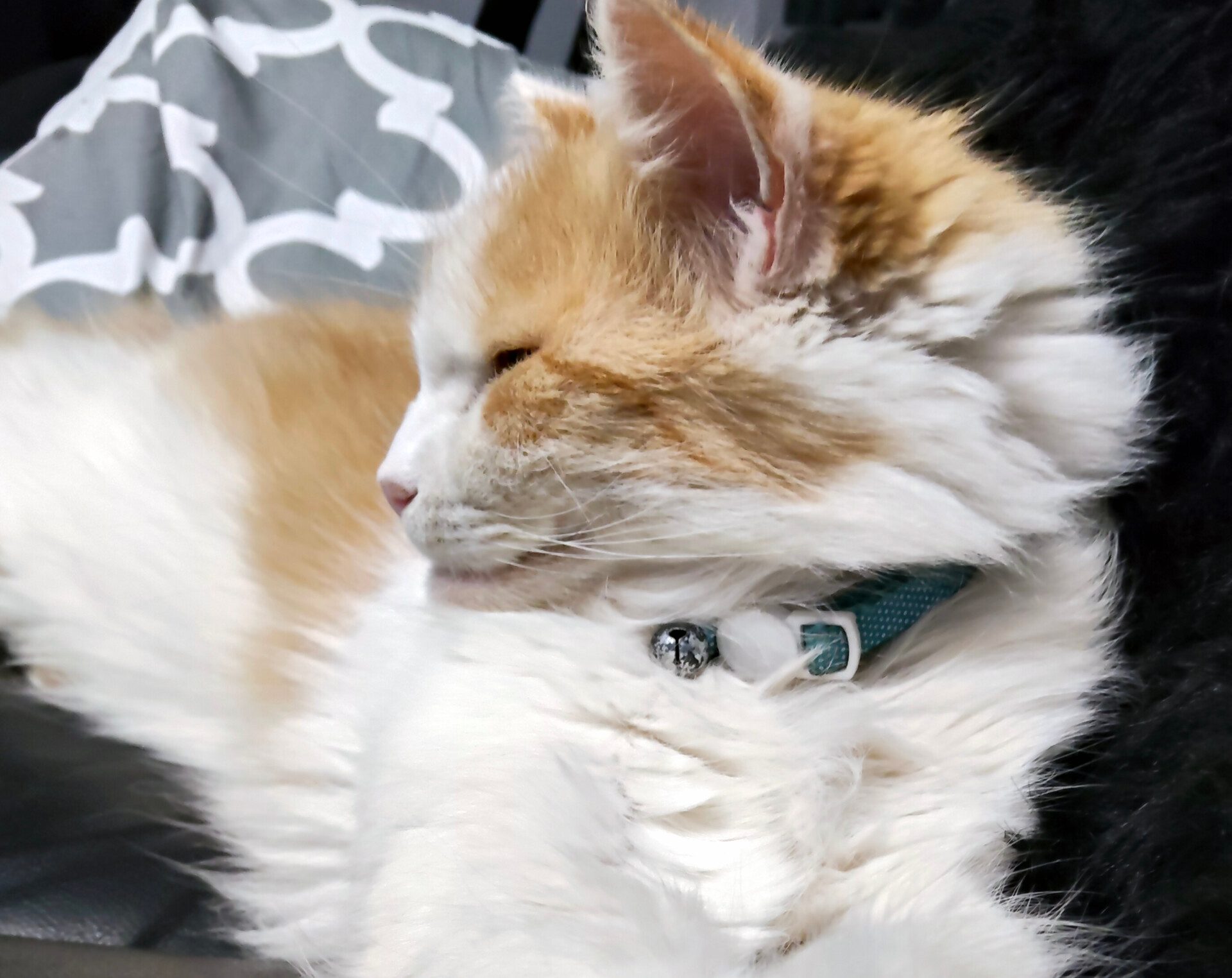 I’ve got a cat named Eddie and even though, to be honest, he can be very annoying at times – he wakes me up in a night, meows for treats, knocks things off my shelves – he’s so special to me. He’s pretty much my baby but, equally, he looks after me when I’m sad. If I’m really upset about something, he sometimes jumps up on the bed with me and purrs on my lap until I feel a bit better. Contrary to popular belief, my personal experience has taught me that cats are very sensitive to emotion, are intuitive and empathetic, and can acutely tune into our feelings.
That’s why when I’ve lost cats in the past, it’s been so devastating. Sometimes I feel like I can understand them better than people, and sometimes I feel like they understand me better than people do too.
Tell us about your experience of supports that you’ve been involved with.
I access disability support at SIT to help me with my study and time management. They’ve been good at simplifying assignments, so they make sense to me, and helping me complete assignments on time. I’m very lucky to have tutors who are understanding of my situation, who’re determined to see me succeed and want to make accommodations to achieve that, because they know how important it is for me to complete this degree. Hopefully next year I’ll be graduating, and that’s going to be a massive milestone. I’m grateful for their help and everything they’ve done for me over the years.
At University of Otago, where I studied at for a little while, I found the support was lacking, unfortunately, in comparison. For several reasons, I ended up leaving in 2022, then I shifted to SIT and found it a much better learning environment for my needs. At Otago, the lecture rooms were huge – so many people, so overwhelming, just in the way they were designed. It was also hard to talk to tutors individually because there are so many students in the same class. So, there wasn’t much one-on-one support. Tutoring, if it was done, was by older students, and they were helpful, but they didn’t have the same level of expertise as the professors. I’d say it was a mixed bag. My experience won’t be everyone’s experience who chooses to go there, but it wasn’t the best for me.
What else? I have support through CCT (Community Care Trust) a couple of times a week, with independent living, and they help me to do various errands that either require transport by car (because I don’t have my full driver’s licence yet), or things like paperwork or sorting out medical appointments that I may find tricky to navigate on my own.
I’m grateful to have these supports and people who are understanding, because otherwise I would really struggle and feel afraid to ask for help when I need it.
Did you have support in primary and high school too?
I had teacher aides who supported me and it was good to have them. I did experience, unfortunately, some teachers that were not very patient with me and were not accommodating of my learning needs.
I actually remember one incident when I was very very young, when I was shamed by a teacher for not being able to answer a very simple maths question. I was really intelligent in some areas, and lagging in others, and this teacher couldn’t comprehend that. For a very long time during my childhood, even into my teenage years, I really struggled with numbers and maths. It was genuinely almost painful for me to learn. It was so bad that, at one point, the highest number I could count to was 12, and I was like, “It’s not normal for someone my age, is it?” It’s better than that now.
But yeah, I struggled with maths and social skills in general, and lots of PE activities, sports. Anything involving hand-eye coordination I was terrible at, quite frankly. Oh, and dodgeball, I hated that game because it’s basically a game of trying not to get smacked in the face! I’m glad those days are over. It made me despise so many different types of exercise for years afterwards. It’s only recently that I’ve been able to enjoy physical activities without thinking of embarrassing moments at school – feeling I was unfit, or not fast enough, reflexes too slow to react, poor balance as well. That was hard.
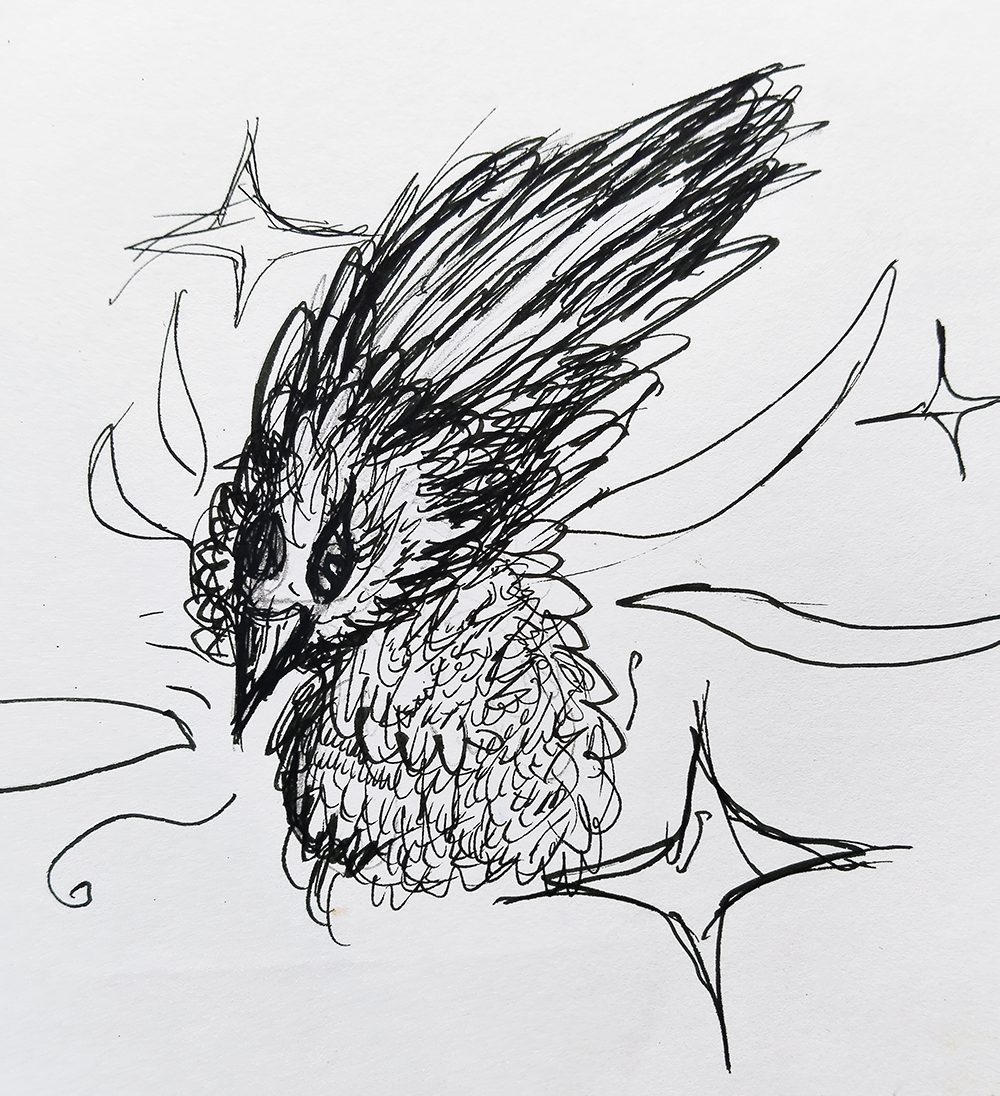
Beth’s phoenix sketch
In terms of the things I’m good at, though, I’ve always been quite strong in my English writing skills from quite a young age. My first short story, I wrote at about seven. I’ve also always been interested in science and wider STEM knowledge. I’ve had all sorts of different special interests relating to that. At one point, I was obsessed with astronomy and the solar system. Another time, I couldn’t stop talking and thinking about dinosaurs and palaeontology. I had a massive dinosaur book that my sister gave me, intended for adults. I couldn’t understand all of it, but I carried it with me everywhere – I loved the dinosaur pictures. And of course, birds as well. I got many quite advanced bird books when I was very young because I wanted to know absolutely everything there was to know about birds. Still very much into birds today.
Learning and growing with autism is by no means an easy experience, and I’ve had my fair share of social and emotional challenges. At the same time, autism has also given me a unique insight for detail, a bold, questioning nature, and a passion for causes I care about.” From a speech Beth wrote in 2019, at 17 years old, when she spoke at an Altogether Autism Network meeting.
What changes have you observed in society’s attitudes towards autism over the last decade?
I’ve found that understanding of autism and other neurodiverse conditions has changed over the last few years. In some ways, it’s improved but I still feel like there’s quite a bit of stigma around it and negative stereotypes. Unfortunately, I don’t think that’s going to go away anytime soon.
In some ways it has gotten worse, with the whole debacle about vaccines causing autism. It is just such a regressive idea that has been debunked multiple times, and people are still going on about it. It’s exhausting. And then people saying, “Oh, there’s only so many autism diagnoses now because people are eating bad chemicals in their food, or because of wokeness or whatever.” Autism is not socially transmitted and it’s not a disease. It’s a condition you have at birth, and it’s not spread by people talking about it. It makes me so angry when I hear about people talking like that.
Also, I’ve seen a bit of an uptick in the use of anti-disabled slurs, like the R slur, which some people still use, and think it’s fine. I feel very sad whenever I see it, say, in an Instagram comment as a joke in the conversation, because I was bullied with that word a lot in school. It’s like being stung every time I hear it.
What about the language now available to discuss Autistic experiences?
I do think in some respects it has improved. I personally quite like the term neurodiverse. I was talking with my friend who’s also AuDHD like I am, and she personally really dislikes it, because, in some ways, it can reduce autism to just a personality trait rather than something people can really struggle with, a disability. That’s a fair opinion to have.
In my personal opinion, I like it because the word itself implies that there’s natural variation in the brains and neurotypes we have, and that variation is not inherently bad. Others may think differently. Also, while terms like high functioning and low functioning, can be seen as, I guess, bit loaded by some people, I find them helpful for describing what a person needs in terms of support. I find them to be mostly neutral descriptors that help us to understand what a person needs for a good quality of life.
My formal diagnosis was Asperger Syndrome (AS), back in 2006. I can see why the term Asperger’s was phased out as well, because it does have some problematic history attached to it, also because AS isn’t an inherently different thing from autism. It’s just a higher level of functioning, typically.
Looking back over the years, what has had a massive impact on you and what has changed for you over time?
I’d say one of the biggest things for me was learning to recognise my needs, to communicate them and what supports I require, and to respect myself by acknowledging what I need is different from a neurotypical person. (For example, I find myself going less out of my way to interact with people I don’t know because socialising does take a lot of mental energy for me, even when I enjoy it.) How I think and feel is going to be different from the average neurotypical person, and that doesn’t make me any less. Basically, I’ve learned to support my self-esteem.
That part’s got easier. What’s got harder? Some sensory sensitivities. I find that I’m more sensitive to loud noise. I don’t really know why, I guess it’s just an ageing thing. Not really ageing, I’m not that old! But I am more sensitive, as the years go by, for sure. Now, I make sure that while I’m in public, or on a plane, I’ll have my noise cancelling headphones on me, or earbuds, or both. Because I never completely know what sort of noises I might be dealing with.
As I’ve gotten older, through therapy and experience, I’ve learned a lot more about how my autism affects me, and rather than seeing it exclusively a bad thing, I’m better at recognising what I may find challenging, but also my natural strengths. Sometimes that takes a bit of work – to recognise them and bring them out.
I’ve been trying to embrace my strengths by leaning into my creativity, dressing in my own unique style. I really enjoy various forms of alternative fashion including Japanese style or J fashion, but I like goth clothes, too. I’ve got a lot of vintage clothing items as well. I really like 50s and 40s styles, in particular. So, I’ve been working on my confidence to express myself as who I am, rather than having to completely mask and act like someone who I’m really not.
A little bit of masking is fine for getting by in day-to-day life. I do have to do it while I’m at work, for example. I work part-time at a restaurant serving customers, and of course, a certain degree of masking is required for that. I only work about six to eight hours a week, because I’m aware of my limits. If I wear a mask a bit more than that, then it would really start to burn me out. That’s why I do it in such short intervals as well. My shifts are typically only two to three hours long.
Looking to the future, what are your priorities/aspirations?
My most important goal is to finally have my studies done and graduate. Aside from that I’d like to continue working on my creative projects. Often with my creative work I find that it is not so much about the destination as the process of creating. I’d also like to work towards getting my full driver’s licence as that’s important for doing a lot of conservation jobs. Then look for a job with an organisation like DOC (Department of Conservation) because I really like to be out in the field, and I know from my times volunteering with DOC that the work made me feel energised. It just felt right. I’d like to find a career that feels aligned with my values and the sort of impact I want to have on the world.
When I was four, I required speech therapy. Now I have gained excellence in NCEA Level 1 and 2 and aspire to study for a university degree next year. Without autism, I might have never discovered the awe of nature and the immense value of caring for it, or experienced the joy of my creativity coming to fruition. Every one of the challenges I have faced with autism has, in the long run, made me a much stronger, kinder, and wiser person than I was before. I wouldn’t trade my autism for anything.” From the speech Beth wrote at 17, for an Altogether Autism Network meeting.
* Updated edition is now called All Cats Are on the Autism Spectrum, by Kathy Hoopmann